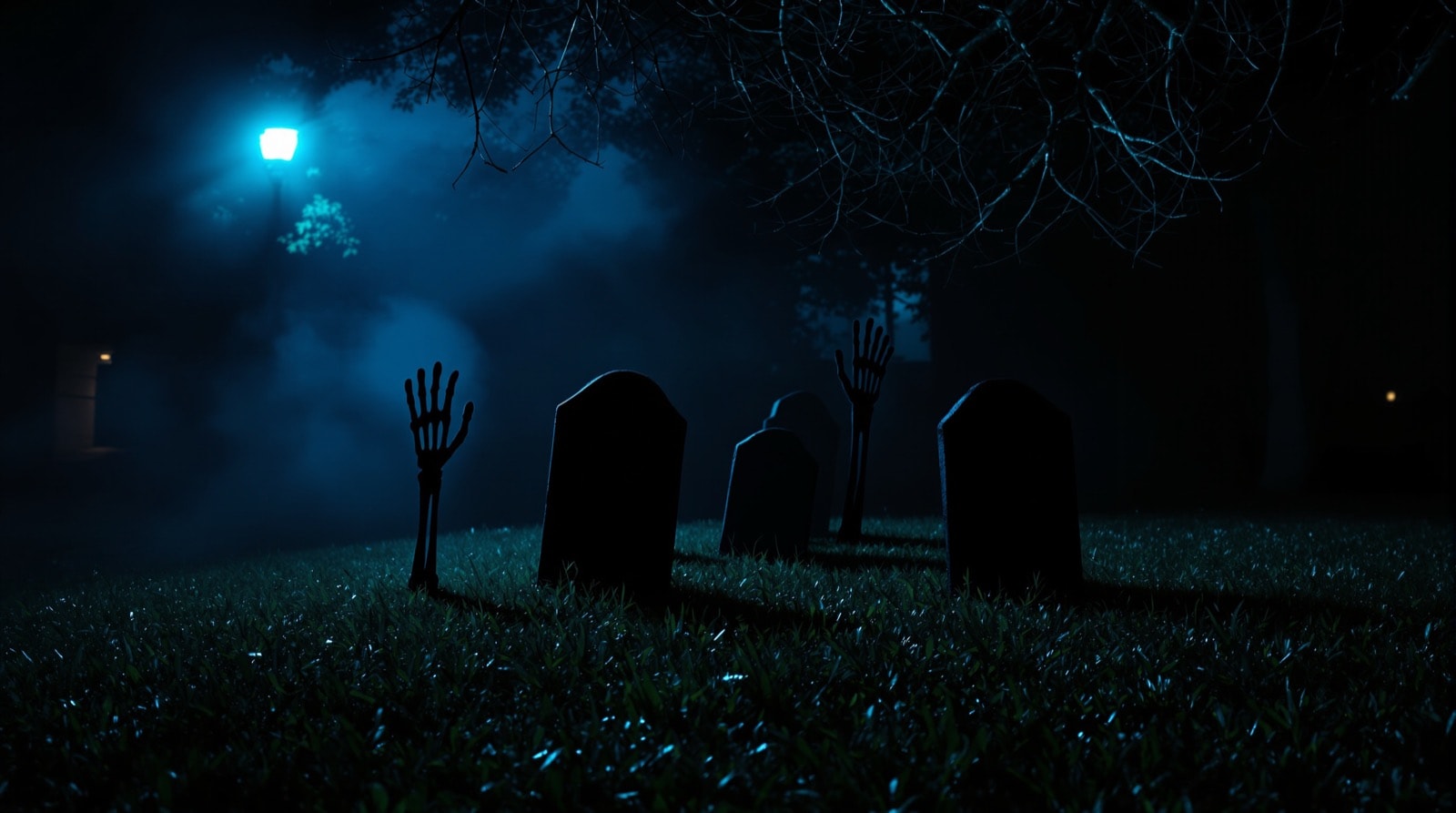
Home haunting is the practice of building a Halloween display rather than buying one — treating a front yard, a porch, a garage or a single room as something to be designed, constructed and lit. It is a craft hobby that happens to have a deadline, and the deadline is the reason it produces such inventive work: nobody has time to do it the expensive way.
The hobby has a long amateur tradition and a substantial folk history behind it. The Library of Congress maintains a research guide to Halloween and Día de Muertos that traces the customs the modern holiday grew out of, and it is worth reading if only to notice how much of what a home haunt does — the lights, the effigies, the invitation to be frightened at a threshold — is very old indeed.
What separates a haunt from decorations
Bought decorations are objects. A haunt is a scene. The distinction matters because it changes what you build and in what order.
- A haunt has a sightline. There is a place the visitor stands and a direction they look. Everything is arranged for that view, and anything behind it can be plywood and duct tape.
- A haunt has one idea. A graveyard, a laboratory, a flooded cellar. Props that support the idea earn their place; props that are simply spooky dilute it.
- A haunt is built for its light. Almost nothing here works under a porch bulb. Displays are designed for one or two low, coloured, directional sources, and the props are built to read under exactly those.
- A haunt has depth. Two or three planes of props — something close, something mid, something barely visible at the back — read as a space. A single line of objects reads as a shelf.
How a display is planned
Almost every haunt is built backwards from one hero prop. Something is made that turns out better than expected, and the rest of the scene is designed to give it a context. A stacked-skull pedestal wants a graveyard around it; a head in a jar wants shelves of other specimens; a flame box wants something to be burning.
The practical sequence that most builders converge on:
- Pick the scene in summer. The materials that make this hobby cheap — dollar-store foam board, clearance costume fabric, post-season skeletons — are only available out of season. Planning in July is what makes a display cost thirty dollars instead of three hundred.
- Build the volume first. Tombstones, ground cover, big silhouettes. These are quick, they fill space, and they define the sightline.
- Build the detail last. Detail work is what runs over. If the scene is only half detailed on the thirtieth of October it still reads; if the scene has no volume it does not.
- Light it in the dark, on site, before Halloween. Every builder discovers that props they spent weeks on are invisible and props they threw together are the ones people see. That discovery should happen a week early, not on the night.
- Plan for weather. Anything in a yard will be rained on and blown at. Foam needs a stake and a pipe sleeve; wire props need a proper anchor; paper and tissue props need to be under cover or accepted as disposable.
Starting from nothing
A credible first-year yard display is roughly: four or five foam tombstones, a pair of zombie arms coming out of the ground between them, two or three wire ghosts in a tree, and one coloured floodlight low to the ground throwing everything into silhouette. Every item on that list is on this site, all of them together cost less than a single shop-bought animatronic, and the result is a scene rather than a shelf.
The indoor equivalent is a specimen shelf: the head in a jar, the eyeball tube, the alien specimen and a couple of glowing potions, all lit from one side with a lamp on the floor. It fits on a bookcase, it takes a weekend, and it works on adults far better than anything with a rubber mask on it.
Working safely and considerately
Two things are worth saying plainly. The first is that this hobby involves heat, blades and mains electricity, and the tools and safety page exists because the casual tone the craft is usually written in does the reader no favours. The second is that a yard display is public. Trick-or-treaters include very small children; paths need to stay lit and unobstructed, stakes and cables need to be somewhere nobody walks, and anything that startles should not be at the height of a four-year-old's face. The US Fire Administration's holiday guidance covers the fire side of that, which is the part people consistently underestimate.
The rest of the projects are indexed on the projects page, grouped by technique.