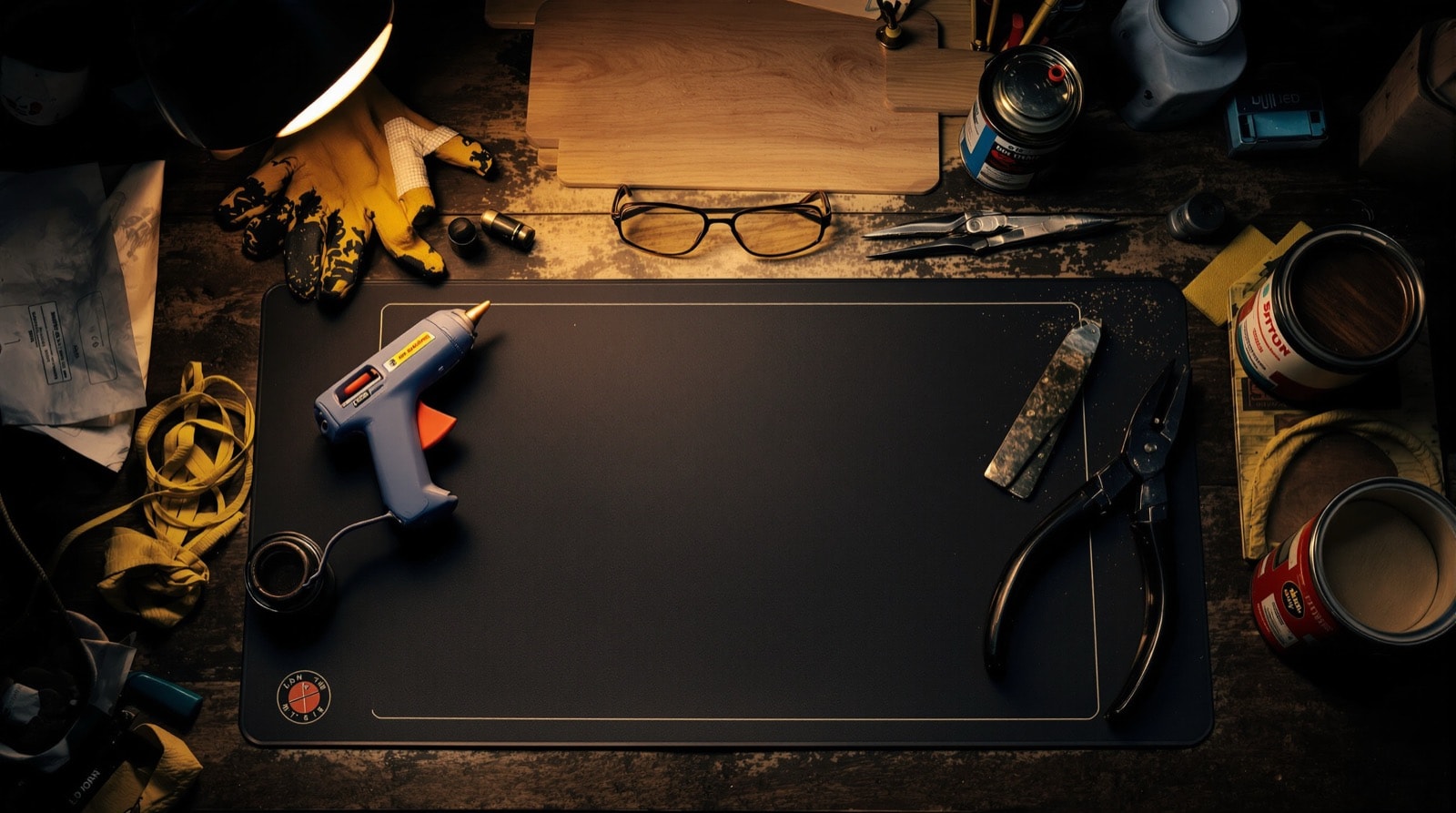
Prop building is usually written up in a cheerful voice that treats a 190 °C glue gun and a single-edged razor as comic props. They are not. Nothing on this site is especially dangerous, but almost all of it involves at least one of heat, blades, sharp cut metal, solvent vapour or mains electricity, and the injuries that happen in this hobby are boringly predictable. This page is the short list of habits that prevent them.
Read it once. Then read the specific note at the top of any tutorial that carries one.
Hot glue
A standard glue gun runs at roughly 190 °C, and high-temperature sticks are hotter still. Molten glue is worse than boiling water because it does not run off — it sticks to skin and keeps delivering heat until it sets, which is what produces the deep contact burns this hobby is known for.
- Never catch a run in your hand. The reflex when a bead runs off a prop is to cup it. Let it fall. Work over a scrap board or a silicone mat and let the waste hit that.
- Hold work with pliers, a clamp or a gloved hand when gluing near your fingers — particularly on small parts like skull eye sockets, where the temptation is to steady the piece with a fingertip an inch from the nozzle.
- If glue does land on skin, cool it under running water immediately and leave the set glue where it is until the skin underneath has been cooled thoroughly. Peeling hot glue off straight away takes skin with it.
- Unplug the gun when you stop. A hot gun laid on its side on a bench of tissue, foam and fabric is the most likely fire in this entire hobby.
- Work on a heat-tolerant surface. Hot glue will mark a table, and it will melt thin plastic and some foams on contact.
Blades, wire cutters and sharp edges
Craft knives, single-edged razors, tin snips and side cutters all appear in these projects. The usual advice applies and is worth taking literally.
- Cut away from your body, and never towards the hand holding the work. The release cut in the cheap skulls build is the classic offender because the shell wants to be steadied from the inside.
- A blunt blade is more dangerous than a sharp one. It needs force, and force is what makes a blade skid.
- Cut sheet metal is genuinely vicious. Tin, ductwork and termite shield come off the snips with a burr that will open a finger without being noticed. Hem the edge over with pliers, or run two layers of duct tape along every cut edge, before the piece goes anywhere near a build. This applies directly to the flame box deflectors.
- Bend and tape wire ends. Every wire armature on this site should have its cut ends turned over with pliers and taped. A protruding coathanger end at eye height in a dark yard is the one injury risk this hobby has that affects visitors rather than builders.
- Wear eye protection when cutting wire. Coathanger wire under tension releases fast and unpredictably when it parts. See OSHA's overview of eye and face protection.
Power tools
A jigsaw and a cordless drill appear in the sign and candy dish builds. Clamp the work — a plywood offcut held by hand and cut with a jigsaw is how people cut themselves. Keep the cable behind the tool, let the blade stop before lifting it, and follow the general guidance on hand and power tool safety. Safety glasses are not optional for either tool.
Paint, stain, ink and solvent vapour
Wood stain, sealant and spray paint are the solvent-carrying materials in this hobby, and they are used in exactly the wrong place: a closed garage or a basement in October.
- Stain and spray outdoors, or with a door and a window genuinely open and air moving. "The garage door is up a foot" is not ventilation. The EPA's summary of volatile organic compounds and indoor air quality explains why the concentration indoors gets so much higher than people expect, and OSHA's ventilation overview covers the principle.
- Read the label on the tin. Stains and sealants vary enormously in what they contain and what protection they call for.
- Rags soaked in oil-based stain can self-heat. Do not ball them up and leave them in a bin. Lay them flat outdoors to dry, or put them in water in a sealed metal container. This is a real and well-documented cause of house fires.
- Gloves. India ink, stain and acrylic all come off skin eventually; solvent cleaners are harsher on you than the paint is. Nitrile gloves cost almost nothing.
Lit props, fans and mains electricity
This is the section that matters most, and it is mostly about one project. The flame box puts a mains-powered floodlight inches from loose costume fabric inside a wooden box with a fan running. Built as described it is safe; built carelessly it is a fire.
- The wire bulb cage is not optional. Its only job is to guarantee that fabric and the plastic fan grill can never touch the hot lamp. Build it first, not last.
- Never run a lit prop unattended, and never overnight. Put lit props on a switched strip you turn off when you leave.
- Use outdoor-rated cable and an RCD or GFCI outlet for anything in a yard. Damp ground, extension leads and mains lighting are a combination that deserves respect. OSHA's electrical safety overview is a reasonable starting point.
- Inspect cords every year. Props live in a basement for eleven months and get chewed, crushed and cracked. A damaged cord retires the prop until it is repaired.
- Prefer a cool lamp where you can. Much of the heat problem in lit props disappears with a modern LED lamp — though note that a genuinely convincing flame effect depends partly on the warm colour and hard shadow of a point source, so test before committing.
- The NFPA's Halloween fire-safety guidance and its general home fire-safety material are both short and directly relevant.
Props in a public yard
A yard display is used by strangers, in the dark, some of them very small.
- Keep the path lit and clear. Nothing to trip on, no cable across a walkway, no guy line at shin height.
- Twelve-inch spike nails and rebar stakes are driven flush and are not left proud. A stake at ankle height in the dark is the classic haunt injury.
- Anything a child will reach into — the candy dish is the obvious case — must be stable enough not to tip, and must have no exposed bolt threads, screw points or wire ends inside it.
- Consider that some visitors will be frightened for real. A startle prop at the height of a small child's face is a bad idea however well it is built.
Children in the workshop
Plenty of these projects are built with children, and most of them are suitable — carving foam, draping cheesecloth, painting, bending pre-cut wire. The parts that are not are the glue gun, any blade, the tin snips, the jigsaw and anything plugged in. Adults do those steps. That division lines up almost exactly with the step numbering in these tutorials, so it is easy to hand over the right parts.
What this page is not
It is workshop practice, not medical or emergency advice. For a burn, a cut, a solvent exposure or any injury that is more than trivial, stop and get proper medical help — do not consult a Halloween website about it.