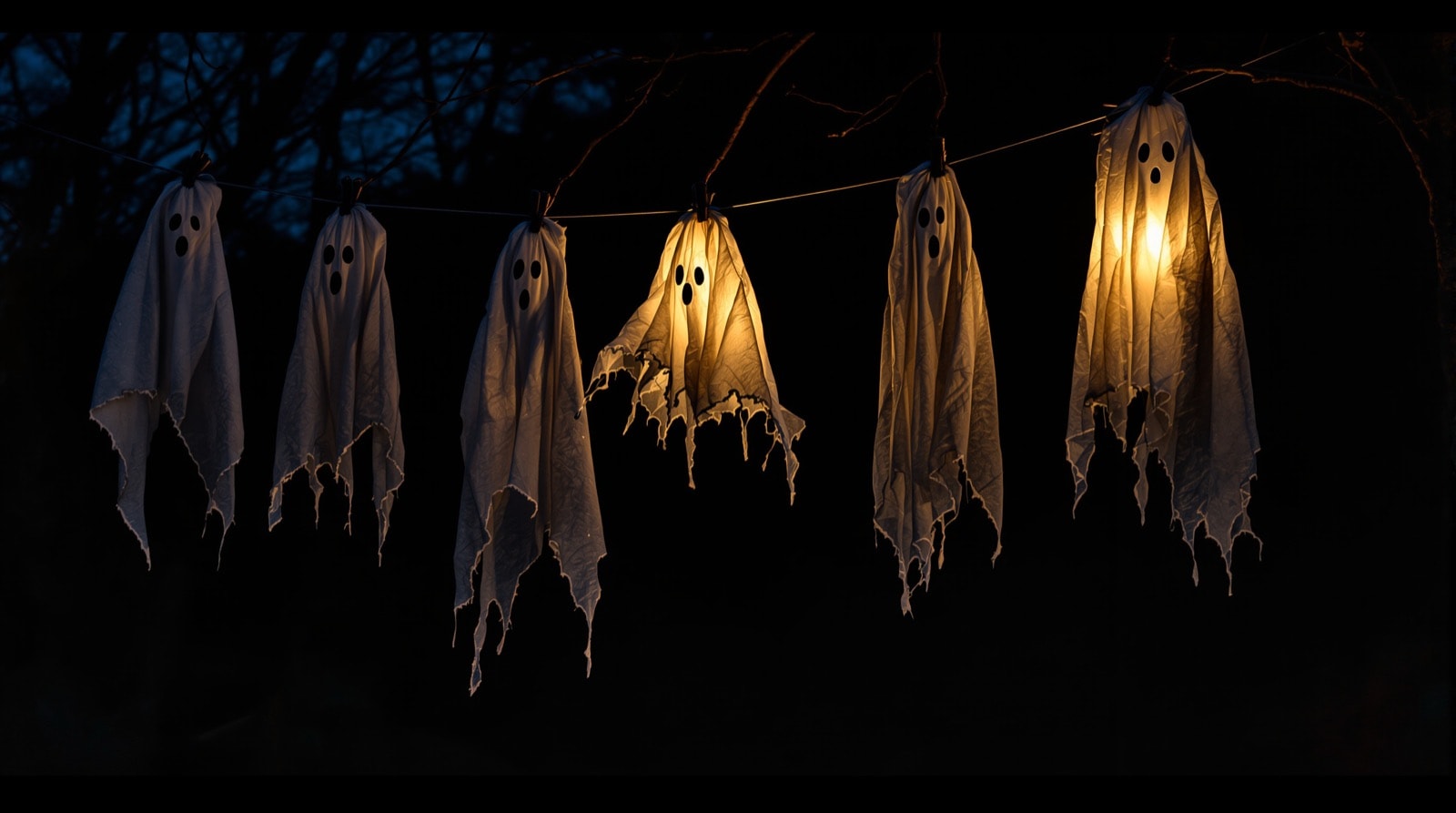
About wire ghosts
These are the cheapest and easiest props you can make, and every home haunter should have several of these spirits floating around. A bent coathanger and a length of cheesecloth, and the whole thing is done in twenty minutes.
They are also the props that photograph best at night, and the ones that do the most work for the least effort in a yard, because a pale shape moving slightly in a dark tree does more than almost any static prop can.
Materials
- Several wire coat hangers. The stronger the hanger, the better it will support the weight of the cheesecloth.
- Cheesecloth. There is no prescribed amount — it varies with personal taste and the size of ghost you are making. You cannot go wrong with several yards of it.
- One container of white fabric dye. The ordinary supermarket sort sold for home dyeing. This is what makes the ghosts glow under blacklight. If you do not need your decorations to glow, ignore any of the steps that involve the dye.
- Wire cutters and pliers.
- Fishing line, for hanging.
Making the prop
Step 1 — Bend the armature
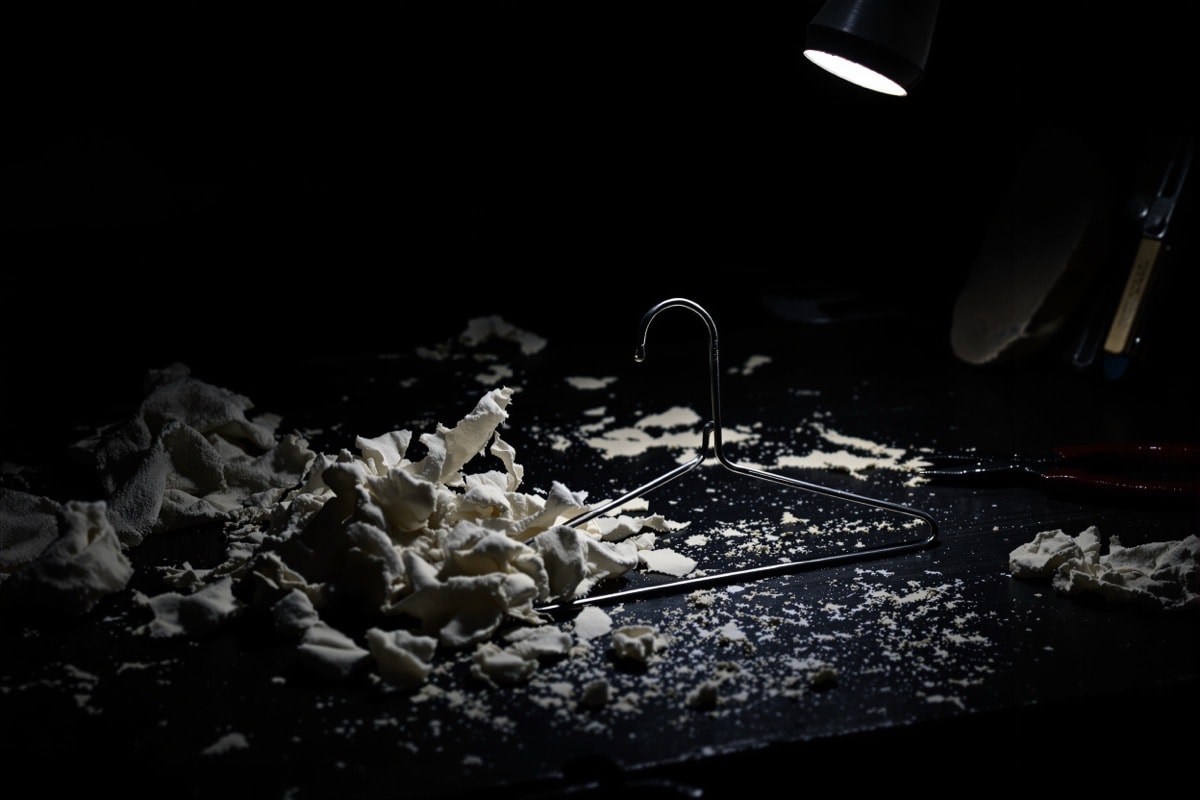
Cut the hook off a hanger and straighten the wire. Then bend it into the shape of a figure seen in silhouette: a small closed loop at the top for the head, a wider loop below it for the shoulders and chest, and the two ends left long and splayed slightly outward so the cloth hangs away from the frame at the bottom.
The proportion is what matters. A head loop of roughly four inches with shoulders around ten inches across gives a convincing small figure; scale both up together for a larger one. What breaks the illusion is a head that is too big — under a sheet of cloth, a large head loop reads as a lampshade.
Do not make the frame a closed outline of a body. It only needs to define the head and the shoulders; everything below that is done by the cloth, and the less structure there is down there the better it moves.
Turn every cut wire end over on itself with pliers so nothing sharp is left. See the safety page — hanger wire is springy and whips when cut, so wear eye protection.
Step 2 — Dye the cheesecloth
Cheesecloth as sold is an off-white, slightly yellowish cream and does very little under ultraviolet light. Soaking it in white fabric dye, made up and used according to the packet, changes that completely: the dye contains an optical brightener, which is a fluorescent compound that absorbs UV and re-emits it as visible blue-white. Under a blacklight the treated cloth blazes while everything around it stays dark — the same physics as the glowing potions.
Dye it, rinse it, and hang it up to dry fully before draping. It stiffens slightly as it dries, which actually helps the folds hold their shape.
Skip this step entirely if the ghosts will not be under UV; undyed cheesecloth is perfectly good in ordinary light.
Step 3 — Age and tear the cloth
Before draping, tear the bottom edge of the cheesecloth into ragged points and pull a few holes through the body of it. A rectangle of cloth with a hemmed edge reads as fabric; a torn, uneven, holed piece reads as a shroud.
Cheesecloth tears easily and unevenly, which is exactly what you want. Vary the lengths of the points so no two ghosts have the same silhouette.
Step 4 — Drape it
Drape the cheesecloth over the frame and your ghost is finished. Let it fall naturally rather than arranging it — the point of the open frame is that the cloth finds its own folds. A twist of thread at the neck, just below the head loop, defines the head and lets the rest hang free.
Several layers of cloth, offset from one another, produce far more depth than one — the underlying layers show faintly through the top one and the ghost gains a body rather than being a curtain.
Scaling up
A single hanger makes a fairly small ghost. For a larger one, use exactly the same technique but with heavier-gauge wire of greater length — the kind sold in rolls at farm and hardware stores makes a life-sized figure easily. The proportions and the method are unchanged; only the wire gets thicker. Above about three feet, add a second wire hoop at hip level so the cloth does not simply collapse inward.
Hanging them
Fishing line, always. Invisible line is what makes a ghost float rather than hang, and at night the suspension disappears entirely.
Site them where there is air movement. This matters more than anything else about the prop: a ghost in a doorway, under a porch, or in the outer branches of a tree will drift and turn on its own all evening, and that slow movement in the corner of a visitor's eye is worth more than any amount of detail. A ghost in still air is a sheet.
Hang them at different heights and at different distances into the dark, so some are clearly visible and others are barely there. The half-seen ones are the effective ones. Add a skull inside the head loop and you have a spectre, which is the next project along.