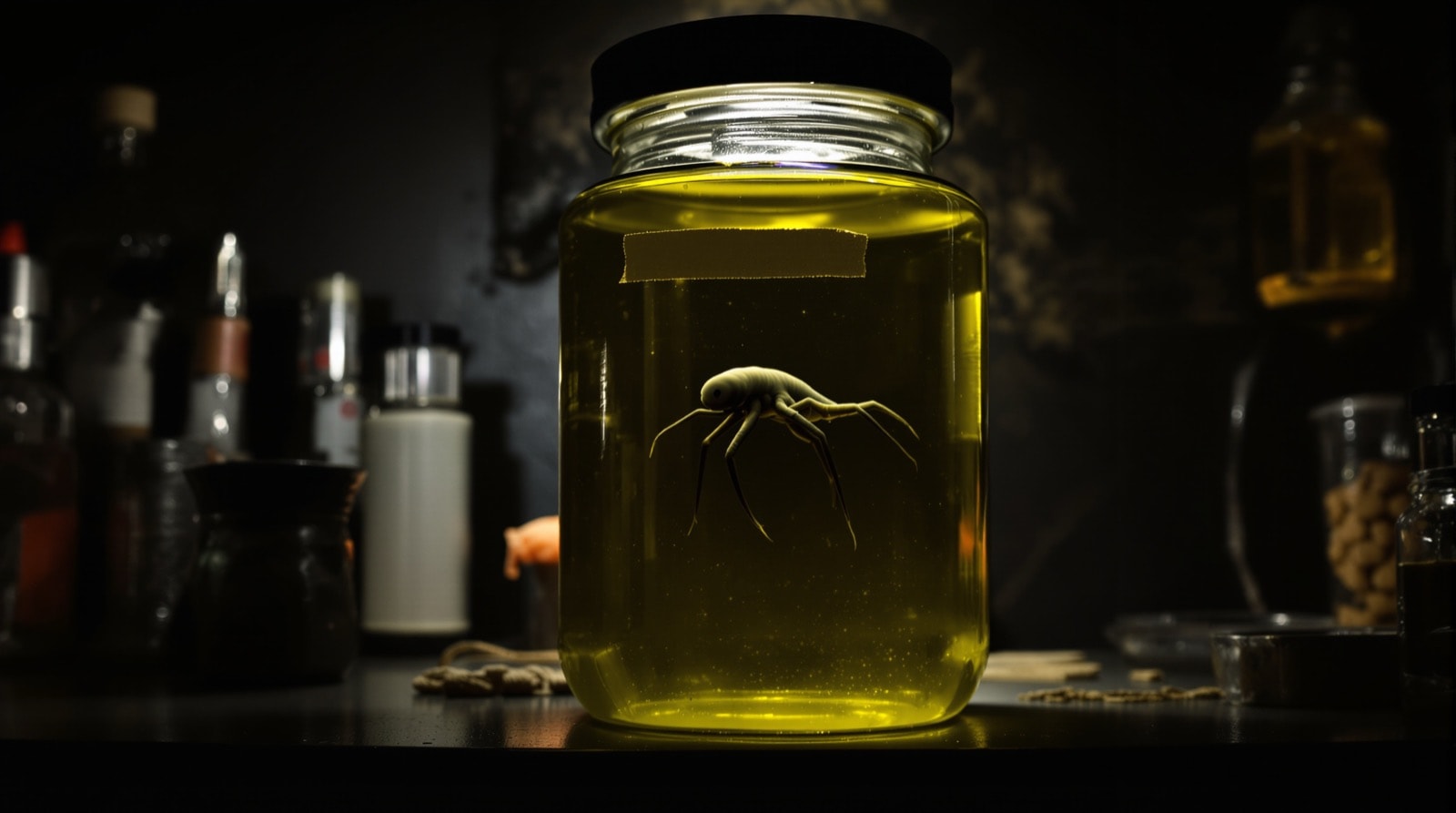
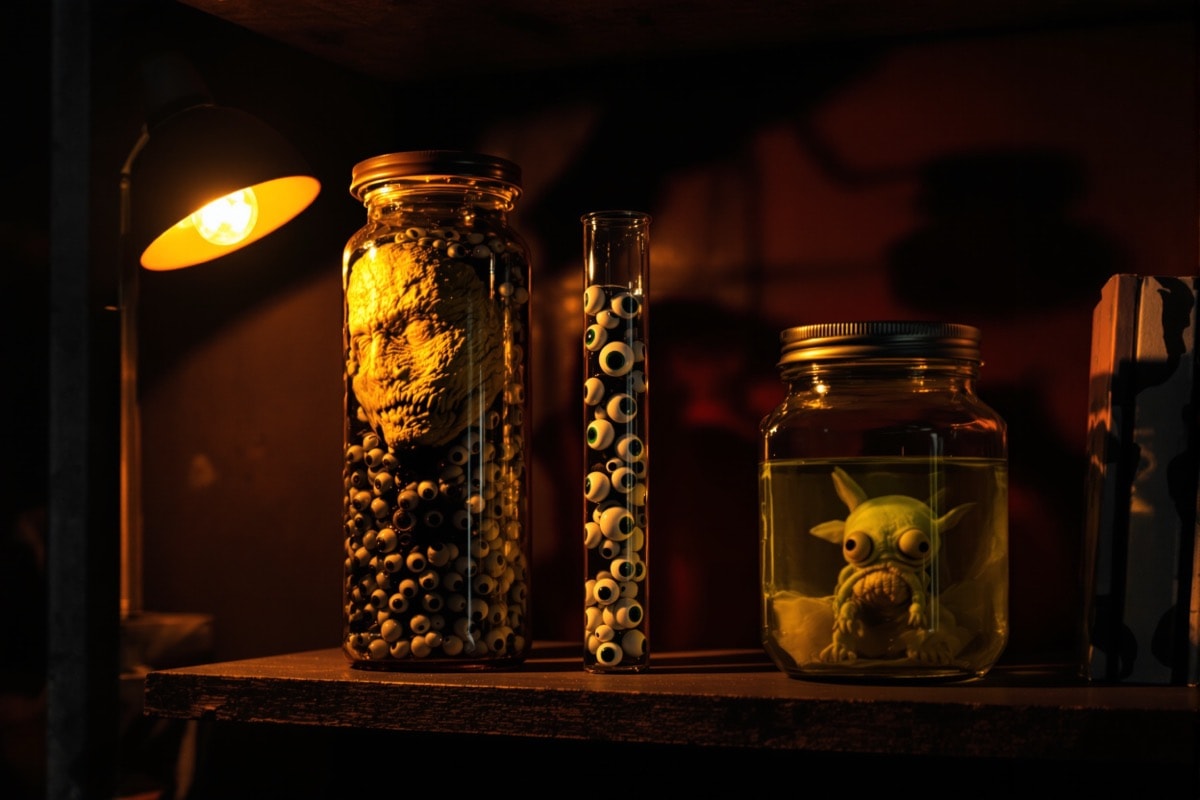
A preserved creature floating in a jar of yellow-green fluid. It is an honest project to describe: on its own, in a bright room, it looks like a painted doll in a pickle jar. Put it on a dim shelf beside the head in a jar and the eyeball tube, though, and the three of them stop being props and start being a collection — and a collection implies a collector, which is a considerably more unsettling idea than any one object on the shelf.
That is the real lesson of this build and it applies well beyond this project: some props work by being good, and some work by making the props around them make sense.
Materials
| Item | Notes |
|---|---|
| A doll | A water-filled doll is ideal — see step 1. Otherwise anything small and vaguely limbed. |
| A large glass jar | A catering pickle or sauce jar from a bulk store. It must be wide enough at the neck to take the doll. |
| Grey acrylic paint | Plus paper towel for the wipe-back. |
| Gloss black acrylic | For the eyes. |
| Glow-in-the-dark fabric paint | The squeeze-tube kind with a fine nozzle. |
| Food colouring | Yellow and green. |
| Masking tape and a marker | For the label. |
Making the prop
Step 1 — Find your specimen
Look for a small doll destined for a yard sale or a charity shop. The ideal candidate is a water-filled doll — the kind with a soft body full of liquid — for two reasons that both turn out to matter. It has neutral buoyancy, so it hangs in the middle of the jar instead of bobbing at the surface like anything hollow; and it has weight and give, so it wobbles convincingly when the jar is nudged. A hollow plastic doll floats, and a floating specimen is instantly a toy in water.
Pick something proportioned oddly — long limbs, big head — and match the jar to it. The specimen should be a comfortable fit but not squashed: a creature pressed flat against the glass reads as a jammed-in doll, whereas one with an inch of fluid all round reads as suspended.
Step 2 — Kill the colour
Nothing about a doll says "not a doll" more than pink plastic. Paint the whole thing in grey acrylic and then, before it dries, wipe most of it back off with a paper towel. The grey stays in the creases and comes off the raised surfaces, producing an uneven, waxy, cadaverous cast that no flat coat of paint achieves.
Then paint the eyes gloss black, right across the whole eye including the white. That single move does more to remove the doll's identity than everything else combined — a face with no visible sclera reads immediately as not-human.
Step 3 — Build up the surface detail
Using glow-in-the-dark fabric paint from a fine-nozzle tube, draw ridges, veins and markings over the grey. The tube matters: it lets you lay a raised bead rather than a flat brushstroke, so the detail has real relief and catches the light through the fluid.
Concentrate on the head, which is where anyone will look, and then carry a lighter pattern down the body and limbs so it does not stop abruptly at the neck. Symmetrical markings look designed; slightly asymmetrical ones look grown.
Let it dry thoroughly. Fabric paint stays tacky for far longer than it looks, and putting a tacky specimen into water lifts the lot straight off.
Step 4 — Jar it and tint the fluid
Put the specimen in the jar and fill with tap water. Add food colouring a drop at a time until you reach the murky yellow-green of old preserving fluid — that colour is the single most recognisable part of the whole effect and it takes remarkably little dye. Go slowly. Over-tinted water goes opaque, and an opaque jar has nothing to show.
A pinch of dust or a strand of teased-out cotton wool suspended in the water adds sediment and sells the idea that the thing has been in there a long time.
Step 5 — Cap and label
Screw the lid down tight. Then label it: a strip of masking tape with a word in marker pen. Keep the label boring — SPECIMEN 4, a date, a catalogue number — because bureaucratic labelling is far more unsettling than anything dramatic. A jar labelled "ALIEN" is a joke. A jar labelled "07-C / RETAINED" is evidence.
Display
Light it from behind or below, through the fluid, so the specimen appears in silhouette with the glow-paint detail catching the light. Under a blacklight the fabric paint fluoresces and the whole thing lifts considerably. Set the jar back on the shelf rather than at the front, slightly turned away, partly obscured by something else — a specimen glimpsed is worth two on display.
Practically: a full catering jar is heavy and it is full of dyed water. Put it where it cannot be knocked, and not above anything that would mind. Expect to remake the fluid each season, since tinted tap water goes cloudy after a few weeks.