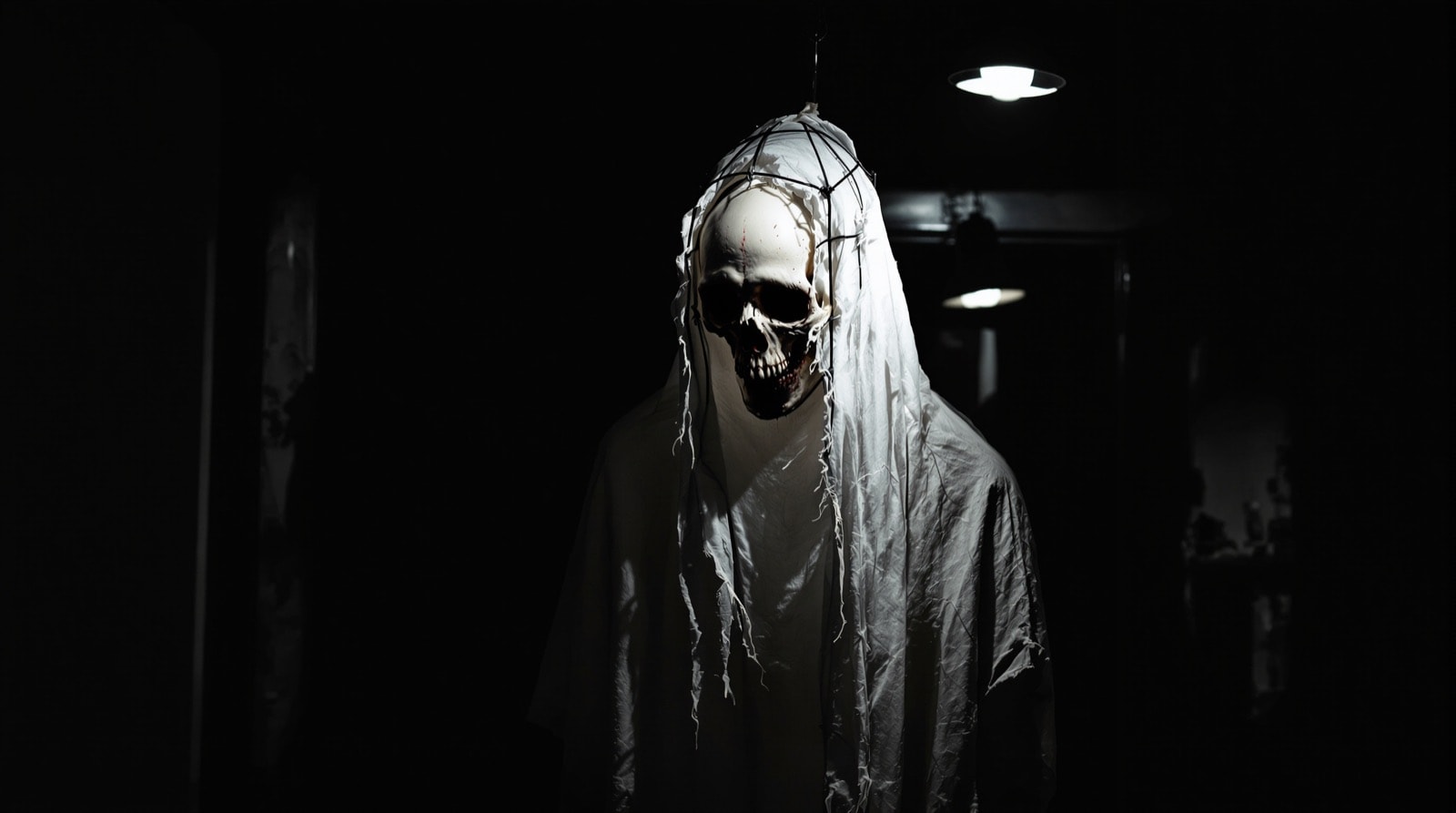
A spectre is a wire ghost with a skull in it. That one addition changes the prop entirely: a draped ghost is a shape, while a spectre has a face, and a face reads from much further away and holds attention far longer.
It is a twenty-minute build on top of a skull you already have, and under a blacklight it is one of the most effective things on this site.
Materials
- A skull. A cheap blow-moulded one is fine; one made with the cheap skulls method is better and lighter.
- Heavy wire — a coathanger, or farm-store wire for a larger figure.
- Cheesecloth, several yards, dyed white if it is going under UV (see wire ghosts for the dye step).
- A screw eyelet, pliers, wire cutters, electrical tape.
- Hot glue, if the skull is a cast one.
Making the prop
Step 1 — Prepare the wire and the skull
Cut the hook off the hanger and straighten the wire, then work out where it will pass through the skull. The wire needs to go in one side and out the other at roughly the level of the temples, well above the cheekbones — a wire through the jaw line lets the skull tip forward and hang wrong.
Mark both entry and exit points before piercing anything, and check them against each other so the wire will run level. A skull skewered crooked never quite recovers; it hangs at an angle that reads as a mistake rather than as menace.
On a thin blow-moulded skull, pierce with a bradawl or a heated nail rather than forcing the wire through — thin plastic cracks. On a hot-glue cast skull the wall is soft enough to take a bradawl easily.
Step 2 — Push the wire through
Cut a length of wire and push it through the skull.
After inserting it, be sure to bend the ends over with pliers to keep anyone from being accidentally poked by the sharp ends. It is worth going further and taping the ends with electrical tape for added safety — this prop hangs at head height in the dark, sometimes where children are walking, and a protruding wire end is the one genuine hazard in the build.
Step 3 — Form the shoulders
Bend the wire to form the shoulders: out from the skull on each side, then down, so what you have is a T-shaped frame with the skull at the top and a shoulder line beneath it.
Roughly ten to twelve inches across suits a normal skull. Wider than that and the cheesecloth starts to look like a tent rather than a figure. Angle the shoulder line down slightly at the outer ends — a level bar reads as a coathanger, and drooping shoulders read as a body.
Step 4 — Fit the hanging eyelet
Screw an eyelet into the top of the skull. This gives a clean single hanging point directly above the centre of gravity, so the spectre hangs level instead of tipping.
If the skull was made using the cheap skulls method, run hot glue around the base of the eyelet once it is in. The glue bonds to the shell perfectly, since it is the same material, and makes the fixing effectively permanent.
Step 5 — Drape
Drape the cheesecloth over the frame and your spectre is finished.
Let it fall over the skull and the shoulders naturally rather than arranging it. Cheesecloth is open enough that the skull shows through as a suggestion rather than a clear shape, which is considerably more unsettling than an exposed skull would be — resist the urge to pull the cloth back off the face. Tear the hem ragged and vary the lengths, and use two or three offset layers for depth.
Display
Hang on fishing line, in air movement, so the whole figure drifts and turns. A doorway, a porch, an open window, or the outer branches of a tree all work.
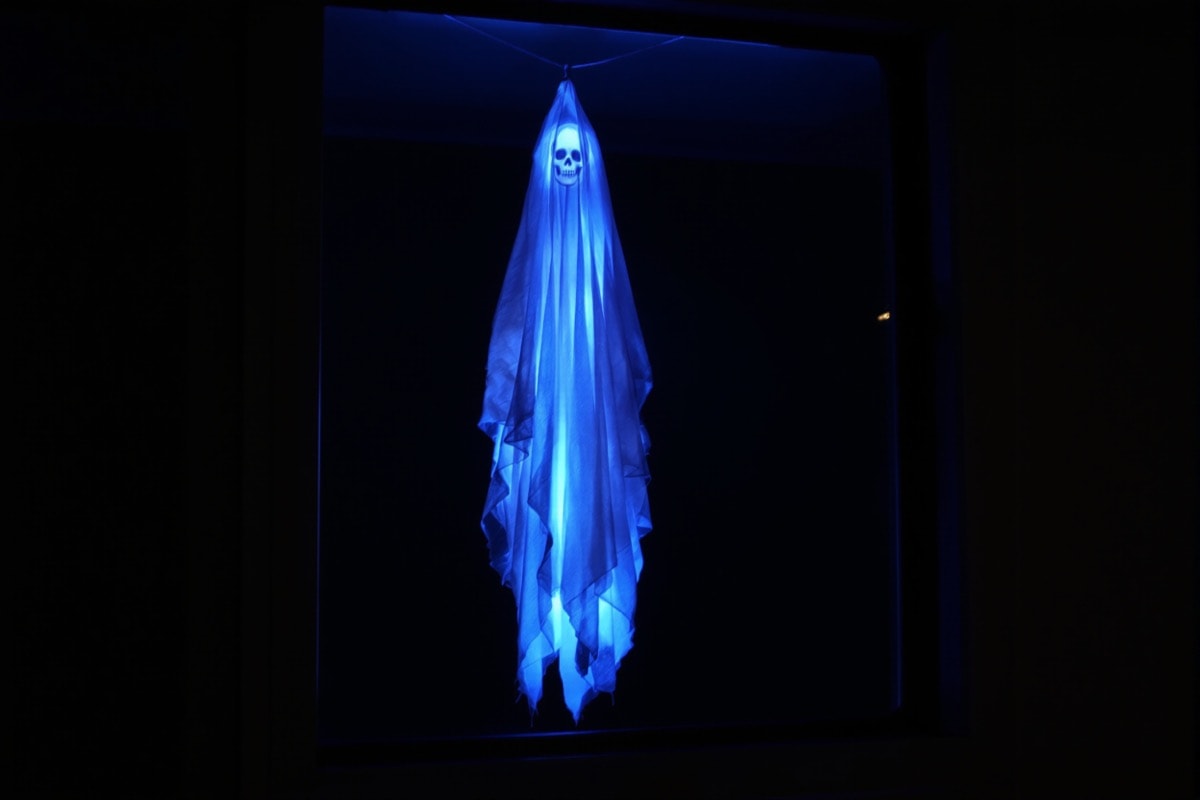
The prop is genuinely good in ordinary light and transformed under a blacklight, where the dyed cheesecloth blazes and the skull inside stays comparatively dark — so the figure reads as a glowing shroud with something solid hidden in it. A spectre hung inside a window with a blacklight behind it, seen from the street, is one of the best effects here for the money.
As with ghosts, use several at different heights and distances, and let some of them be barely visible at the edge of the light.