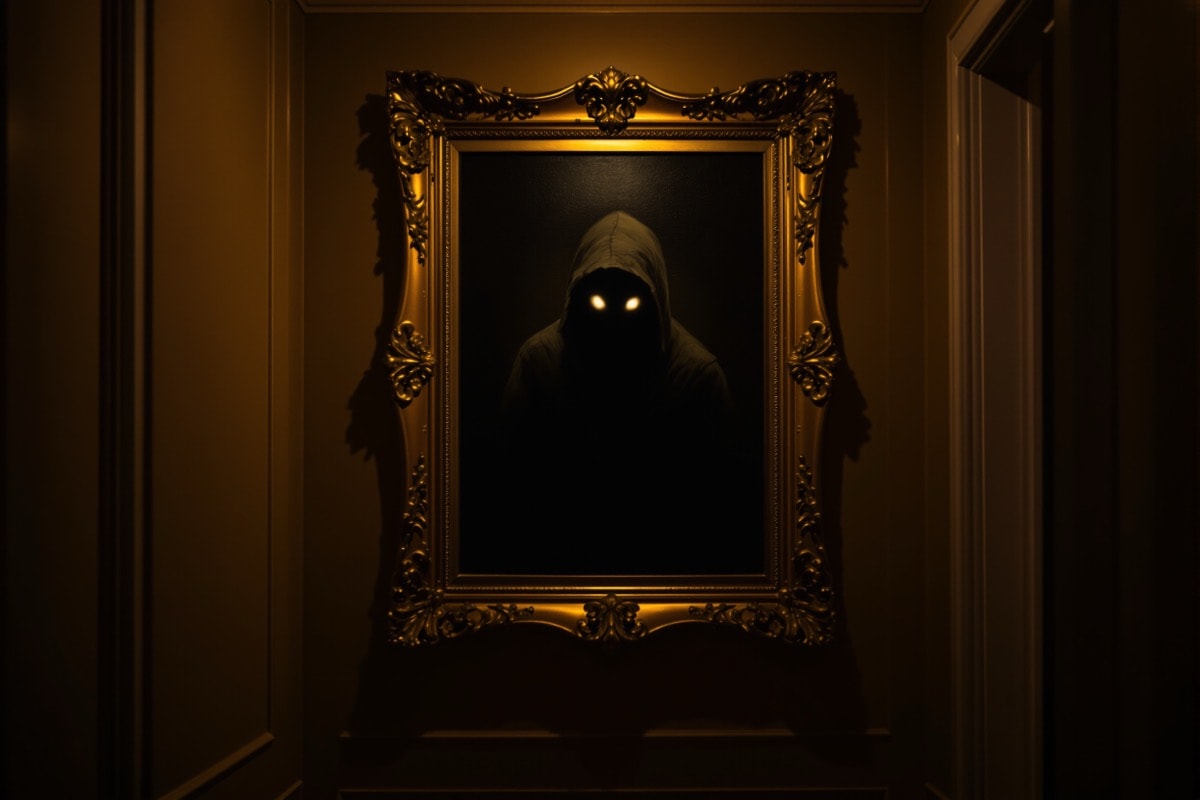
The portrait is built. Almost everything that decides whether it works now happens outside the frame: where it goes, how far away people stand, and what is lighting it.
Viewing distance is the whole prop
The effective range is roughly six to twelve feet. Inside about five feet the recess reveals itself — a viewer can see that the eyes sit in a box behind a hole — and the illusion does not degrade gracefully, it simply stops. Beyond about fifteen feet the parallax shift becomes too small to notice and the portrait goes back to being a picture.
So the prop needs to be hung somewhere that enforces that distance. A hallway wall viewed from a doorway, the far wall of a room across furniture, a stairwell landing seen from below, the end of a passage — anywhere the geometry stops anyone walking up to it. If people can reach the frame, they will, and the first thing they will do is lean in.
Height and angle
Hang it slightly above eye level, so the sitter looks down at the viewer. This is worth doing for two reasons: it is the natural hanging height for a formal portrait, and looking down is inherently more unpleasant than looking level.
The illusion is strongest as the viewer moves across the frame rather than towards it, so site it where the traffic passes sideways. Someone crossing a doorway at eight feet gets the full effect: the eyes swing to follow them the whole way, and the further they walk the more it insists. Someone walking straight at it gets almost nothing until they are already too close.
Lighting
Light it from the front, low, and from one side — a small lamp on a table below and off to the left or right. That does two useful things at once: it puts a slight shadow in the recess, which reads as the natural shadow of a brow, and it keeps the light off the wall behind so the frame sits in its own pool.
Things to avoid. Overhead lighting drops the eye recesses into hard shadow and turns them into black holes. Bright even lighting flattens everything and shows up the paper. And glass in the frame is fatal, because a reflection sliding across the eyes as the viewer moves is exactly the cue that tells them they are looking at a flat surface.
Checking it works
Before the night, stand at the intended viewing spot and walk slowly from one side of the room to the other, watching the eyes. They should track continuously and smoothly. If the effect breaks down at one end of the walk, the eye photograph is probably not centred in its cut-out on that side — which is fixable from the back with a little care. If it never fires at all, the head is almost certainly printed under life size.
Two easy upgrades
A very faint, slow flicker in the lamp — a candle-flicker bulb, or a lamp on a dimmer set low — adds an enormous amount without touching the prop, because it keeps the shadows in the recess moving slightly and makes the eyes feel wet. And a second, smaller portrait hung nearby with ordinary painted eyes gives the real one something to be compared against; visitors who have looked at both tend to distrust the whole wall afterwards, which is a better outcome than one clever picture.